
Ben Nicholson
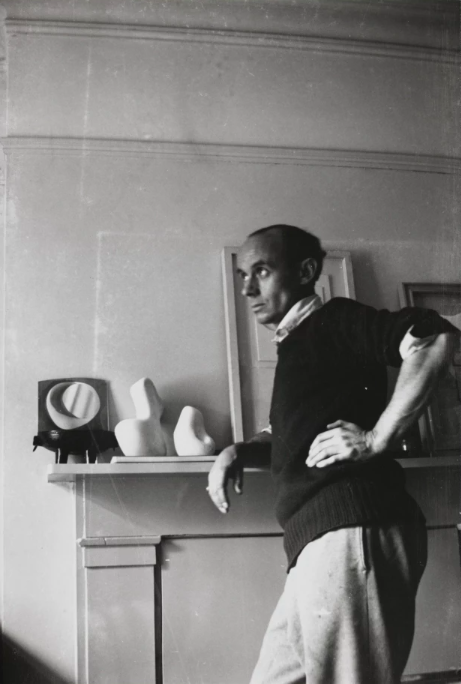
Ben Nicholson (1894–1982) was a leading figure in British modernism, celebrated for his abstract reliefs and carefully structured still lifes. Born in Denham, Buckinghamshire, to the artists William Nicholson and Mabel Pryde, he studied at the Slade School of Art before travelling extensively across Europe and the United States throughout the 1910s and 1920s. During this period, he drew inspiration from Post-Impressionist and Cubist ideas, which would shape his evolving artistic voice. By the mid-1920s, Nicholson began to experiment with abstraction and simplified forms, working alongside his first wife, the painter Winifred Nicholson, and their close friend Christopher Wood. Inspired by the raw, intuitive seascapes of Cornish artist Alfred Wallis, he developed a distinctive, pared-back approach to landscape painting rooted in direct expression.
A significant turning point came with his relationship with sculptor Barbara Hepworth. Their creative partnership marked a move towards a more refined, geometric abstraction, culminating in Nicholson’s iconic white reliefs of the 1930s. These quietly powerful works explore the relationship between light, shadow and form, giving his practice a sculptural quality and a sense of calm balance.
Nicholson has been the subject of major retrospectives at institutions such as Tate, and his work is held in prominent public and private collections worldwide.
WORKS

This publication offers a focused and insightful study of Ben Nicholson (1894–1982), a leading figure in British modernism known for his abstract, geometric works. Written by renowned art critic Dr. J. P. Hodin, the text was published shortly after Nicholson received the Guggenheim Foundation’s first international painting prize, and explores both the spirit and critical relevance of his practice.
Hodin addresses key themes in Nicholson’s work, including the use of geometric abstraction, the dialogue between classical harmony and expressionist energy, and the broader tensions that shaped modern art in the mid-20th century. Drawing from Nicholson’s evolving practice—ranging from early figurative compositions to his iconic white reliefs—the publication situates him within a European context shaped by Cubism, Constructivism, and the influence of Piet Mondrian.
A central figure in the St Ives School, Nicholson helped to establish Cornwall as a significant centre for modern British art. His contributions to abstraction, particularly through his treatment of space and form, continue to influence artists working today.
Author: J. P. Hodin
Printed/Published: Alec Tiranti
Date: 1957
Dimensions: 195 width x 165 height (mm)
+ Shipping Info